
Industry: Power Generation
Service: Vibration Analysis & Dynamic Balancing
Equipment: 11 MW Gas Turbine Generator
Outcome: Reduced vibration levels by over 55% and restored reliable operation
Performed By: Naveen Kondaveeti, Lead Engineer , Mobius Vibration CAT-III certified Vibration Analyst
Overview
An industrial power generation facility experienced severe vibration issues in an 11 MW gas turbine shortly after a major overhaul. The increased vibration levels at the Power Turbine Drive End (DE) bearing raised concerns regarding equipment reliability, bearing life, and the risk of unexpected shutdowns.
Ocean TMS conducted a comprehensive vibration analysis program, including FFT spectrum analysis, orbit analysis, and phase measurements, to identify the root cause. The investigation confirmed rotor unbalance as the primary contributor to the elevated vibration levels. Through precision on-site dynamic balancing, vibration levels were significantly reduced, ensuring stable and reliable turbine operation.
Key Results at a Glance
✔ Reduced vibration from 67/50 microns to 28/22 microns
✔ Identified rotor unbalance through advanced vibration diagnostics
✔ Prevented potential unplanned shutdowns
✔ Improved machine reliability and operational stability
✔ Extended bearing and rotor service life
The Challenge: High Vibration Following Major Overhaul
Gas turbines are critical assets in power generation facilities where reliability and continuous operation are essential. Following a major overhaul of an 11 MW gas turbine generator, operators observed elevated vibration levels at the Power Turbine DE bearing.
The overhaul involved replacement of:
- Power turbine rotor
- Bearings
- Coupling assembly
- Fasteners
- Cup washers
Although the turbine successfully returned to service, vibration readings increased significantly compared to pre-overhaul conditions.
Initial Vibration Measurements
| Operating Condition | Vibration Level |
| Full Speed No Load (FSNL) | 67 Microns |
| Loaded Condition | 50 Microns |
The vibration levels approached alarm thresholds and raised concerns about:
- Bearing damage
- Rotor instability
- Reduced equipment lifespan
- Potential emergency shutdowns
Equipment Details
The turbine-generator package consisted of:
| Parameter | Specification |
| Equipment Type | Twin-Shaft Aero-Derivative Gas Turbine Generator |
| Power Output | 11 MW |
| Bearing Type | Fluid Film Bearings |
| Gas Generator Speed | 7000 RPM |
| Power Turbine Speed | 6504 RPM |
| Generator Speed | 1500 RPM |
| Monitoring Method | Proximity Probe Monitoring |
| Trip Level | 103 Microns Peak-to-Peak Overview of the Gas Turbine |
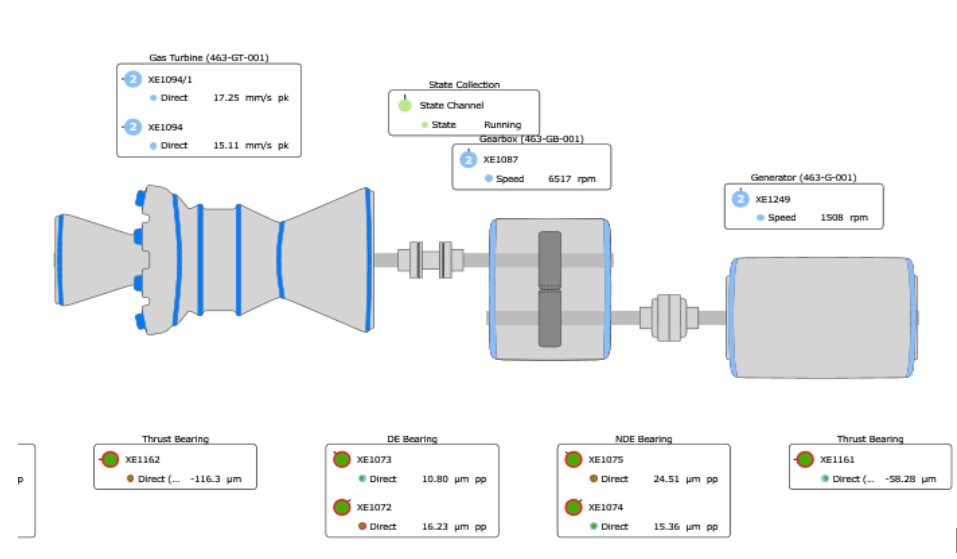
Overview of the gas turbine vibration issue and initial operating conditions following overhaul.
Diagnostic Investigation
To determine the source of the elevated vibration, Ocean TMS engineers performed a detailed condition monitoring assessment using advanced vibration analysis techniques.
Tests Conducted
- FFT Spectrum Analysis
- Orbit Analysis
- Phase Analysis
- Rotor Dynamic Assessment
- Bearing Vibration Evaluation
The objective was to identify whether the vibration originated from:
- Rotor unbalance
- Misalignment
- Mechanical looseness
- Bearing defects
- Structural resonance
FFT Analysis Findings
The vibration spectrum revealed a dominant vibration peak occurring at the turbine running speed.
Key Observation
A significant vibration component was detected at:
1X Running Speed (108.53 Hz / 6515 RPM)
Characteristics observed:
- Highest amplitude in the horizontal direction
- Present on both DE and NDE bearings
- Consistent with classical rotor unbalance signatures
The prominence of the 1X frequency component strongly indicated that the vibration source was directly related to rotor mass imbalance.
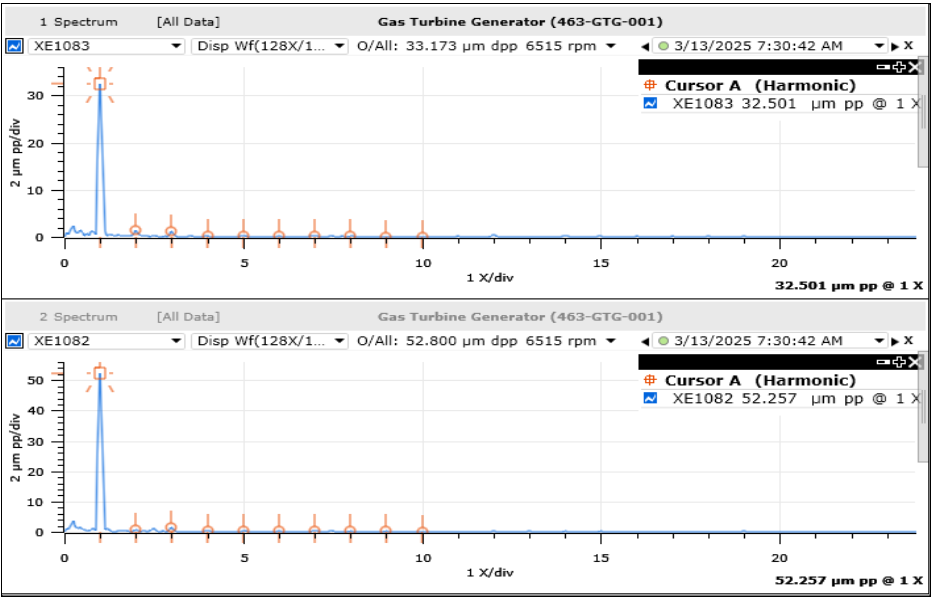
FFT spectrum showing dominant 1X running speed vibration, indicating a likely rotor unbalance condition.
Orbit Analysis Confirmation
Orbit analysis was performed using signals from orthogonally mounted proximity probes.
Findings
The orbit plot displayed:
- Elliptical shaft motion
- Stable orbit shape
- Approximately 57° phase difference between X and Y probes
These characteristics are commonly associated with rotor unbalance in fluid-film bearing-supported rotating equipment.
The orbit pattern provided further confirmation that the vibration was generated by a rotating force acting at shaft speed.
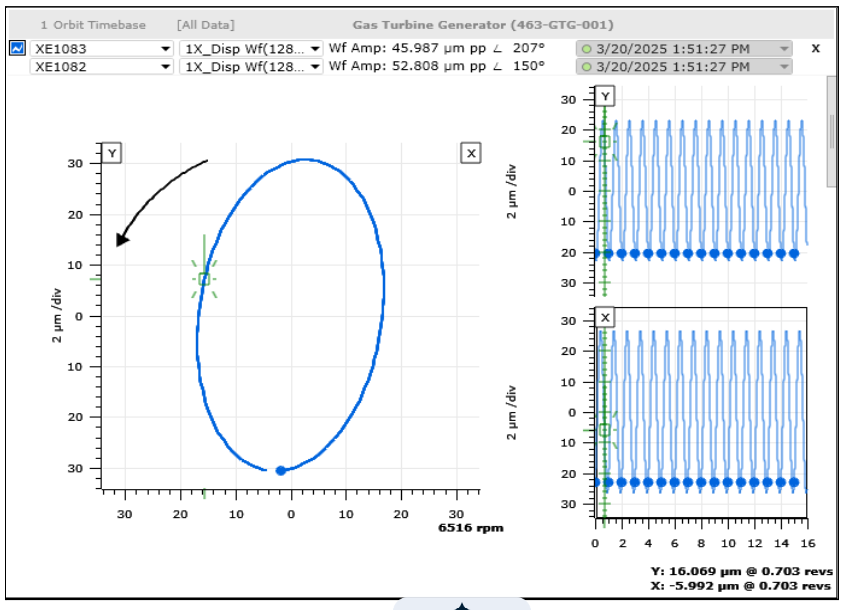
Orbit analysis showing an elliptical orbit pattern and phase relationship typical of rotor unbalance.
Root Cause Analysis
The diagnostic investigation revealed that the vibration increase occurred immediately after the overhaul.
Prior to the overhaul:
- Vibration levels were within acceptable limits.
- No abnormal 1X vibration patterns were observed.
Following the overhaul:
- Rotor assembly was replaced.
- Bearings were replaced.
- Coupling and fastening components were changed.
The replacement components altered the rotor mass distribution, creating a residual unbalance condition.
Root Cause Identified
Rotor unbalance introduced during overhaul and component replacement activities.
The strong 1X vibration response, combined with orbit and phase analysis, conclusively confirmed this diagnosis.
Corrective Action: On-Site Dynamic Balancing
Based on the analysis results, Ocean TMS specialists recommended on-site dynamic balancing of the power turbine rotor.
Dynamic balancing was selected because:
- It could be performed without major disassembly.
- It directly addresses rotor mass imbalance.
- It minimizes downtime and operational disruption.
Balancing Procedure
A correction weight was calculated using balancing principles and vibration response measurements.
Correction Applied
| Parameter | Value |
| Correction Weight | 18.5 grams |
| Location | Power Turbine DE Side |
| Angle | 150° from Key Phasor Reference |
The balancing correction effectively counteracted the unbalance force generated by the rotor.
Results Achieved
Following dynamic balancing, vibration measurements were repeated under operating conditions.
FSNL Results
| Condition | Before Balancing | After Balancing |
| DE Bearing Vibration | 52/46 Microns | 18/14 Microns |
Overall Operating Results
| Parameter | Before | After |
| DE Bearing Vibration | 67/50 Microns | 28/22 Microns |
Performance Improvement
The balancing activity achieved:
- More than 55% vibration reduction
- Improved rotor stability
- Reduced bearing loading
- Enhanced machine reliability
- Lower risk of forced outages
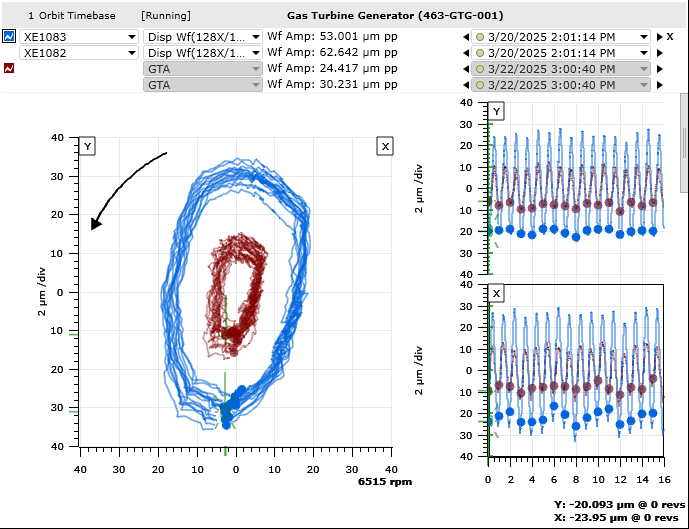
Vibration condition prior to dynamic balancing showing elevated amplitudes.
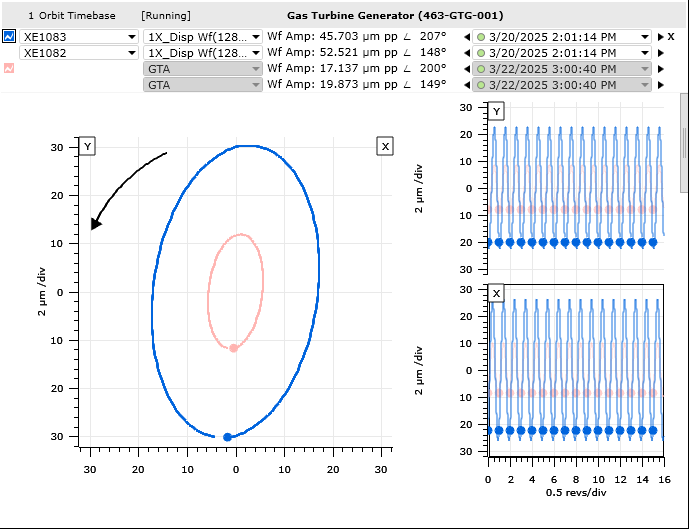
Post-balancing results demonstrating substantial vibration reduction and improved machine health.
Business Impact
The successful balancing intervention delivered measurable operational benefits to the power generation facility.
Reliability Benefits
✔ Improved turbine availability
✔ Reduced risk of unplanned shutdowns
✔ Lower maintenance costs
✔ Increased bearing service life
✔ Improved operational confidence
✔ Enhanced asset reliability
By addressing the root cause rather than treating symptoms, the facility avoided potential secondary damage to critical rotating components.
Why Advanced Vibration Analysis Matters
Many rotating equipment failures begin as minor vibration issues that gradually develop into major mechanical problems.
Advanced vibration analysis enables maintenance teams to:
- Detect faults early
- Identify root causes accurately
- Plan maintenance proactively
- Reduce downtime
- Extend asset life
This case demonstrates how expert vibration diagnostics combined with dynamic balancing can quickly restore equipment performance and prevent costly failures.
Conclusion
The elevated vibration levels observed in this 11 MW gas turbine were traced to rotor unbalance introduced during a major overhaul. Through detailed FFT analysis, orbit analysis, and phase measurements, Ocean TMS engineers accurately identified the source of the problem.
A carefully calculated dynamic balancing correction reduced vibration levels from 67/50 microns to 28/22 microns, restoring stable operation and significantly improving machine reliability.
The project highlights the value of professional and expert condition monitoring services in maintaining the performance and reliability of critical rotating equipment.
Need Help Solving High Vibration Issues in Oman?
As a leading engineering company in Oman, Ocean TMS delivers advanced reliability and asset performance solutions designed to improve equipment efficiency, reduce unplanned downtime, and extend machinery life. With extensive industry experience and a team of skilled specialists, we provide expert:
- Vibration Analysis
- Dynamic Balancing
- Condition Monitoring
- Laser Alignment
- Predictive Maintenance
- Machinery Diagnostics
Our data-driven approach helps identify potential equipment issues at an early stage, enabling maintenance teams to make informed decisions and optimize operational performance. By combining advanced diagnostic technologies with proven engineering expertise, Ocean TMS supports industries across Oman in achieving higher reliability, improved productivity, and long-term cost savings.
Contact our ISO certified specialists today to improve asset reliability, reduce downtime, and maximize equipment perfo