

Project Overview
Equipment: Diesel Transfer Pump
Focus Area: Vibration Analysis and Bearing Condition Monitoring
Motor Power: 55 kW
Operating Speed: 2,965 RPM
Primary Issue: Severe bearing defects in both motor bearings
Prepared by: Bharat Kumar Javvaji, Senior Condition Monitoring Engineer
Background
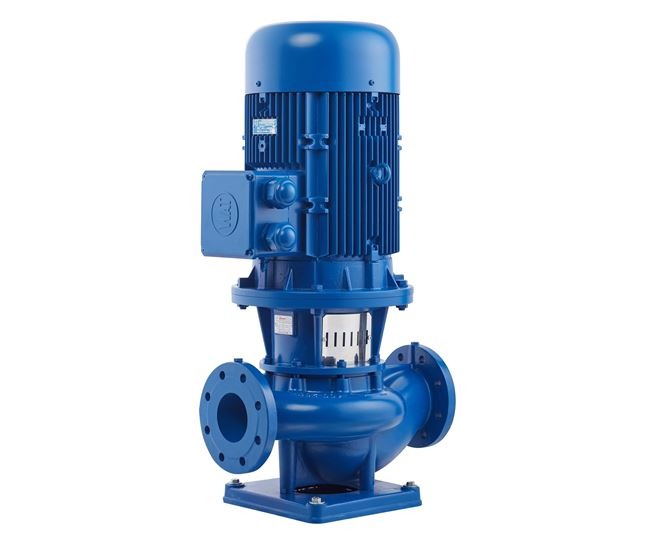
- Motor: 55 KW,
- Speed: 2965 RPM
- Focus: Vibration Analysis
- Motor NDE: 6315 C3
- Motor DE: 6316 C3
- Pump DE: 7314 BECB M
- Pump NDE: 6313 J C3
- Problem: Bearing damage on the motor both bearings
A vibration analysis assessment was conducted on a diesel transfer pump driven by a 55 kW motor operating at 2,965 RPM. The assessment identified elevated vibration levels across the motor and pump, with significant abnormalities detected in both motor bearings.
The findings indicated an advanced stage of bearing deterioration, highlighting the need for timely corrective maintenance to prevent further equipment damage and unwanted downtime.
Challenge
The equipment exhibited vibration levels exceeding acceptable limits, alongside significantly elevated demodulation amplitudes at both the motor drive-end (DE) and non-drive-end (NDE) bearings.
The primary challenges were to:
- Identify the source and severity of the abnormal vibration.
- Detect bearing defect signatures through vibration spectrum analysis.
- Assess the risk of continued operation with deteriorating motor bearings.
- Recommend corrective action to restore reliable equipment operation.
Condition Monitoring and Analysis
DEMODULATION & ACCELERATION SPECTRUMS
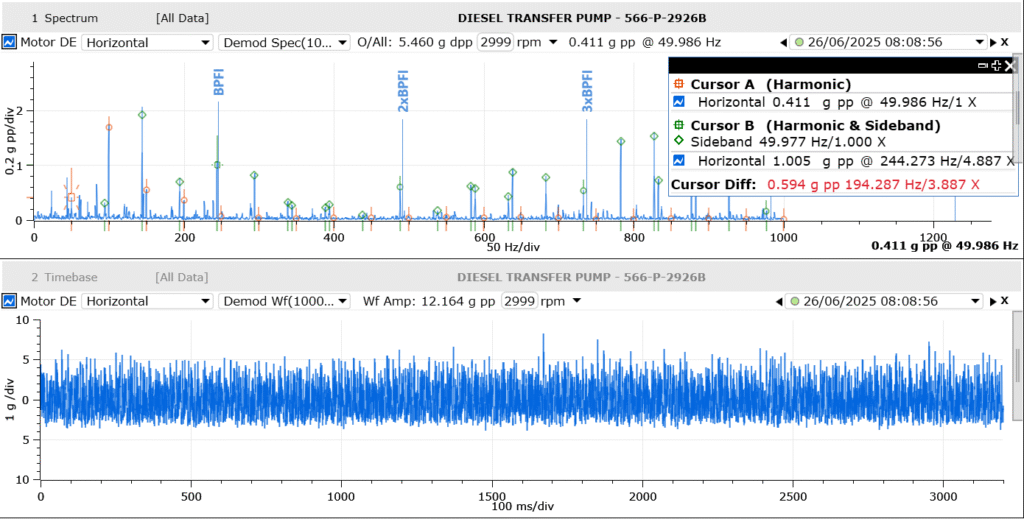
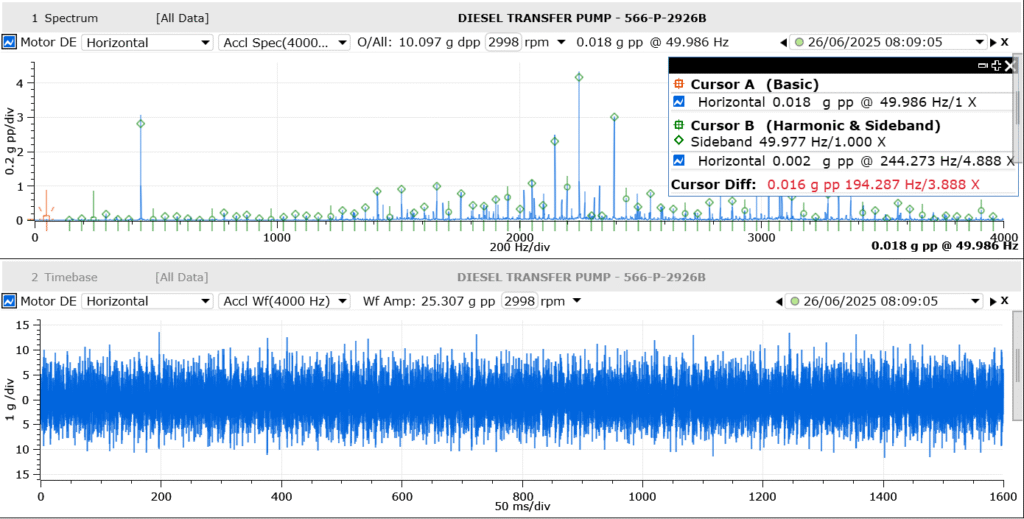
A detailed vibration assessment was performed using acceleration, velocity, and demodulation spectrum analysis.
The investigation identified the following observations:
- High vibration levels across the motor and pump.
- Vibration readings exceeding acceptable limits.
- Increased demodulation levels at both motor DE and NDE bearings.
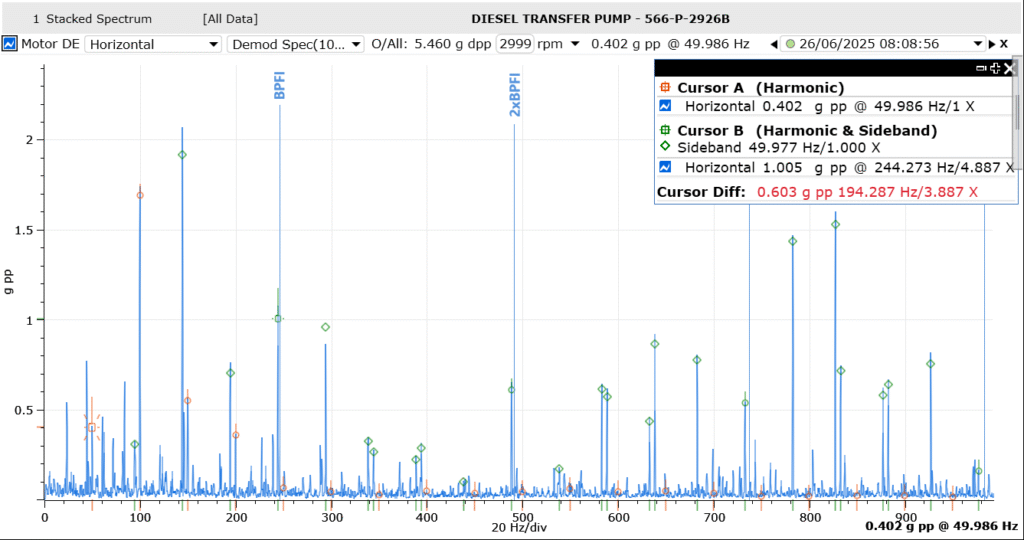
- A prominent non-synchronous frequency at 244.27 Hz, corresponding to approximately 4.88× BPFI, accompanied by 1× sidebands and harmonics.
- Abnormal frequency components visible in both acceleration and velocity spectra, indicating advanced bearing defects.
The combination of elevated vibration levels and abnormal frequency signatures indicated that the motor bearings had deteriorated significantly and required prompt replacement.
Recommendations
Based on the vibration analysis results, the following corrective actions were recommended:
- Replace both motor bearings at the nearest maintenance opportunity.
- Avoid further equipment damage and unnecessary downtime.
- Reassess the machine’s health following the maintenance activities to verify the effectiveness of the corrective action.
Corrective Action Implemented
The recommended motor bearing replacement was completed. Following maintenance, vibration measurements and demodulation spectra were reviewed to evaluate the condition of the equipment.
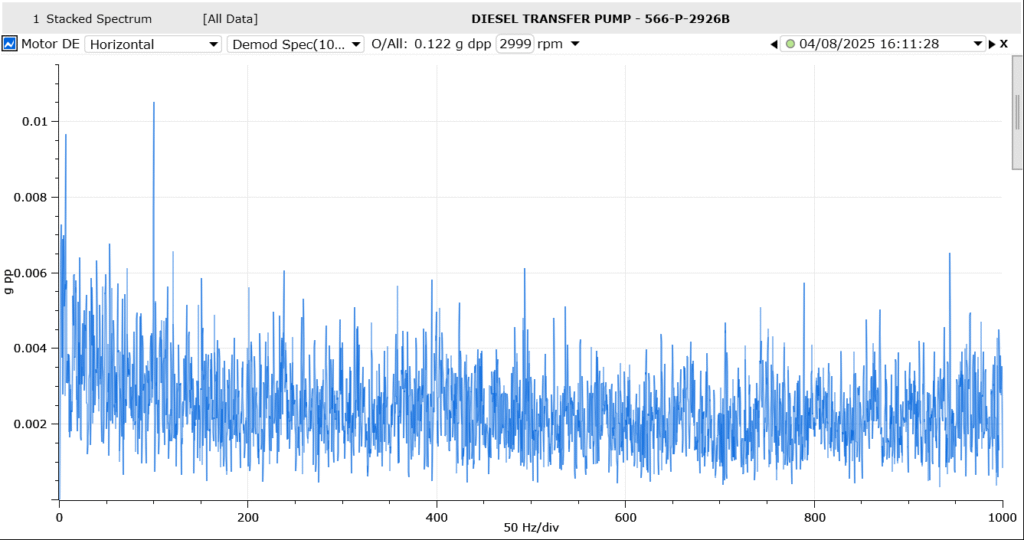
The post-maintenance assessment confirmed that no abnormal bearing defect frequencies were detected and that the overall machine condition had improved significantly.
Results and Performance Improvement
The post-maintenance measurements demonstrated a substantial improvement in the machine’s vibration condition.
| Parameter | Before maintenance | After maintenance |
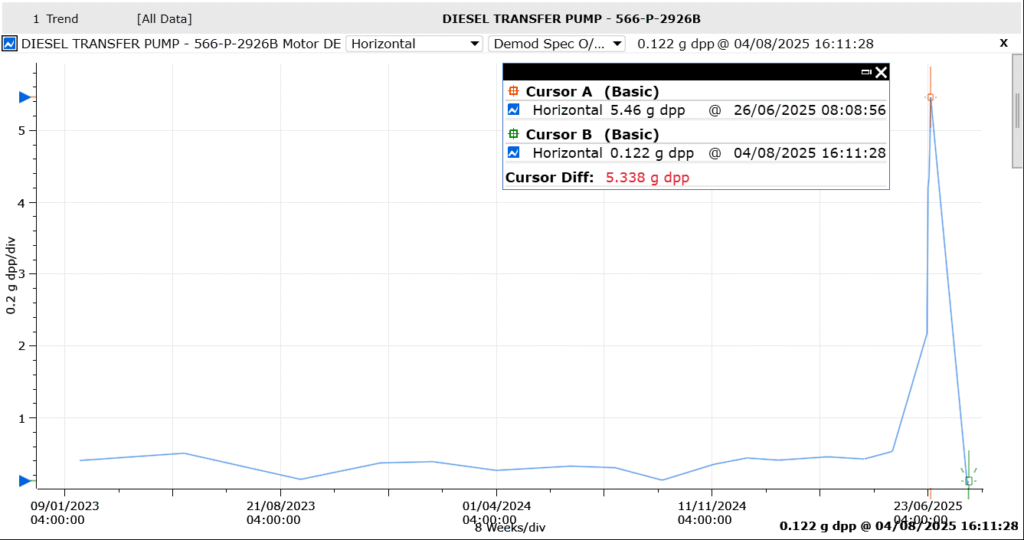
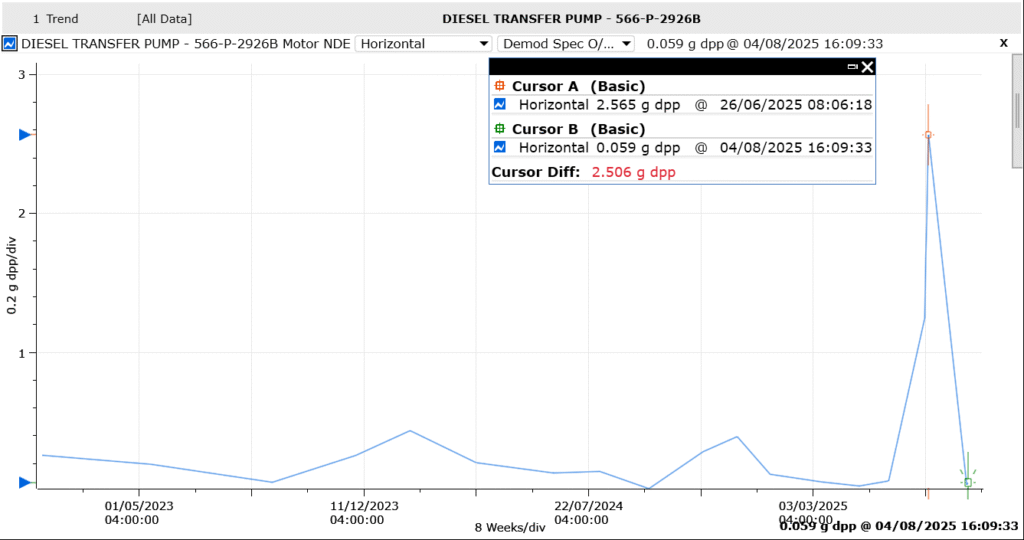
| Demodulation amplitude | 5.4 g dpp | 0.12 dpp |
| Bearing defect frequencies | Abnormal signatures detected | No abnormal defect frequencies detected |
| Overall machine condition | Elevated vibration; critical bearing condition | Improved; within acceptable limits |
The demodulation amplitude decreased from 5.4 g dpp to 0.12 dpp, demonstrating a significant reduction in the bearing-related vibration signature after replacement.
DEMODULATION SPECTRUMS
Conclusion
This case study demonstrates the value of vibration analysis in identifying severe bearing deterioration before it leads to further equipment damage or unplanned downtime.
The detection of abnormal frequency signatures enabled targeted corrective maintenance, while the post-replacement measurements confirmed a significant reduction in demodulation amplitude and an improvement in overall machine condition.
By combining condition monitoring with timely maintenance, equipment operators can make informed maintenance decisions, improve machinery reliability, and reduce the risk of unexpected failures.
Key Takeaway: Vibration analysis enabled the identification of advanced motor bearing defects in a diesel transfer pump, supported timely bearing replacement, and verified the effectiveness of the corrective action through post-maintenance measurements.
Ocean TMS: Improve Equipment Reliability with Expert Engineering Solutions in Oman
Looking to reduce equipment downtime and improve operational efficiency? Ocean Technical & Mechanical Services LLC provides expert condition monitoring services, vibration analysis, predictive maintenance, and industrial engineering solutions across Oman to help keep your critical assets performing reliably.
Contact Ocean ME for reliable, efficient, and cost-effective industrial solutions.