
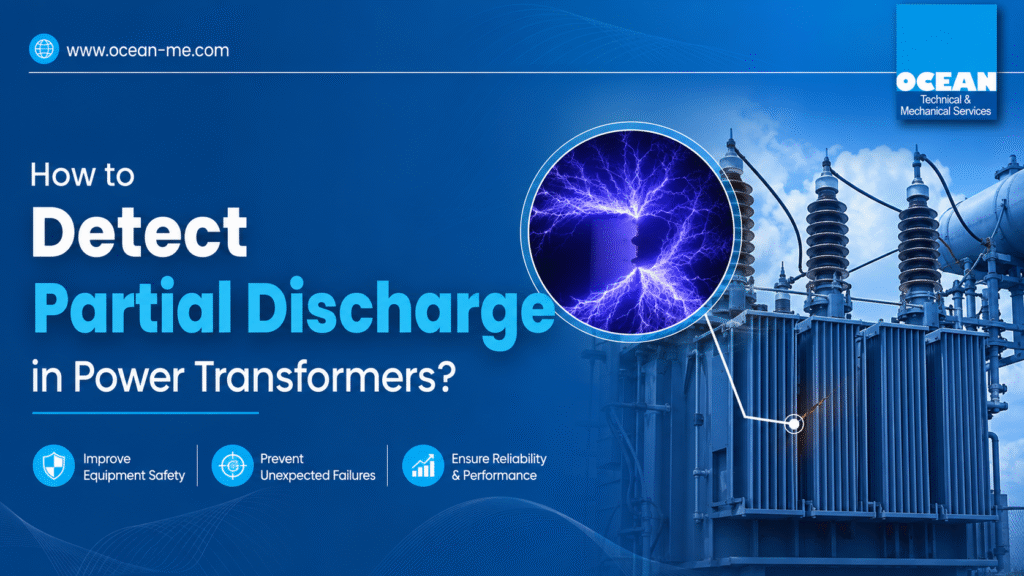
Partial discharge (PD) in transformers due to Insulation defects is one of the key causes of dielectric failure. In transformers, PD is usually seen in windings and bushings when the insulation separating conductors at different voltage potentials becomes damaged, deteriorates, or develops manufacturing defects.
So precisely detecting, evaluating, and accurately locating the source of partial discharge is essential for carrying out proper maintenance and timely repair, which is again vital to ensuring the reliable operation of transformers. PD testing is thought to be one of the most effective methods to assess the transformer insulation during Factory Acceptance Testing (FAT) and Site Acceptance Testing (SAT).
The PD test is particularly beneficial to verify insulation quality, manufacturing standards, and overall transformer condition. Because of this, industries can maintain high product quality and deliver reliability.
International standards have procedures for carrying out PD offline testing. During normal offline PD testing, measurement systems are connected to the transformer’s high-voltage bushing taps and an external high-voltage source is applied. The transformer passes the test if PD levels are below specified limits and show no increasing trend, and proves the insulation is working well.
Once a transformer is in service, PD measurements can be used alongside Dissolved Gas Analysis (DGA) to investigate potential insulation anomalies. If PD activity is detected, acoustic PD measurements can be carried out, which accurately pinpoint the fault location, so that targeted maintenance can be done efficiently, reducing downtime.
The latest PD testing systems provide comprehensive insulation health monitoring, and advanced technologies like noise suppression and source separation improve defect detection and analysis, even in electrically noisy environments.
How to Detect Partial Discharge in Power Transformers?
Partial discharge in power transformers is detected by observing the electrical as well as the acoustic signatures generated when the localised dielectric discharge occurs due to intense stress from high voltage. The detection process is done via the most common method: electrical PD measurement using specialised sensors that are connected to transformer bushings or capacitive taps to pick up discharge pulses.
During Factory Acceptance Testing (FAT) and Site Acceptance Testing (SAT), the transformer would be energised using a controlled high-voltage source. The PD magnitude will be recorded and discharge patterns would be analysed to reach a conclusion regarding the health of the insulation system.
For transformers that are already in service, online PD monitoring is done for continuous assessment without really interrupting operation. When DGA or routine inspections show a chance or possible insulation deterioration, other techniques such as acoustic emission testing, Ultra High Frequency (UHF) sensing, and High Frequency Current Transformer (HFCT) measurements are also used to confirm and accurately locate the PD source.
Combining multiple diagnostic methods improves fault localisation, separates genuine discharge activity from electrical noise, and supports condition-based maintenance; this is so important to prevent insulation failure and extend transformer service life.
What types of diagnostic measurements are normally performed on power transformers and why?
Many diagnostic measurements are used to detect partial discharge in power transformers, with each method providing unique information about the condition of the insulation system. Combining multiple techniques improves the precision in defect detection, minimises false positives, and helps engineers or operators accurately identify cascading insulation faults before they become severe transformer failures.
- Electrical PD Detection Method (IEC 60270): This industry-standard technique measures the electric charge generated by partial discharge in picocoulombs (pC). It is mainly used during factory and site acceptance testing to provide insight into insulation quality and verify compliance with specified PD limits.
- Ultrasonic Detection: PD generates high-frequency acoustic signals that can be detected using ultrasonic sensors. This is a non-invasive method and suitable to be used on energised transformers to locate the physical source of PD without interrupting normal operation.
- Ultra High Frequency (UHF) Detection: UHF sensors capture the electromagnetic signals produced by partial discharge, particularly in gas-insulated transformers and high-voltage equipment. The method offers high sensitivity and excellent resistance to electrical interference, which makes it ideal for early fault detection.
- Transient Earth Voltage (TEV): TEV measurement detects the voltage transients formed when partial discharge occurs within metal-enclosed spaces. It provides a fast and effective way to identify insulation defects in enclosed systems where conventional measurements may fall short.
By understanding the unique requirements and combining these diagnostic techniques efficiently into a hybrid monitoring system, engineers could achieve a more complete understanding of transformer insulation health. Integrating multiple measurement methods improves diagnostic accuracy, enables precise fault localisation, and supports condition-based maintenance to enhance transformer reliability and prolong its service life.
What Is Partial Discharge in Transformers?
Partial discharge in transformers is a localised electrical phenomenon that occurs within transformer insulation, usually in bushings and windings, when high voltage is transmitted. These localised dielectric discharges can gradually weaken and erode the insulation resulting in compromised performance, equipment failure, and costly downtime.
PD normally happens in voids, cracks or within the contaminated insulation. These gaps, when exposed to high voltages, become susceptible to insulation wear and damage. If left unaddressed, this can be a problem that starts as minor and can soon be escalated into long-term damage.
Strategic PD detection and evaluation are critical because by identifying these localised discharges, catastrophic issues can be averted. Especially when industries heavily rely on transformers for power distribution. Proper maintenance, routine inspection and continuous monitoring of power transformers are essential to rule out any anomalies that may affect the integrity of the transformers.
Why Is Partial Discharge Testing Essential?
Partial discharge (PD) detection in power transformers is critical because PD is one of the first cues of insulation health deterioration in Power Transformers. Even though these localised electrical discharges do not suddenly bridge the insulation between conductors, and the fact that it repeats and gradually weakens insulations is critical.
They may appear small at first but create cascading effects like ageing, complete equipment damage, safety hazards and can eventually lead to costly transformer failures if left undetected. So, identifying partial discharge at an early stage is important and it is imperative if maintenance teams need to plan repairs proactively, reduce unplanned outages, and extend transformer service life.
Modern transformer inspections rely on the many advanced diagnostic techniques in the industry, particularly to detect partial discharge before any significant damage occurs. The most well-known methods are acoustic imaging, ultrasonic testing, ultra-high frequency (UHF) monitoring, dissolved gas analysis (DGA), and electrical PD measurements.
Of these methods mentioned, acoustic imaging has invaluable benefits and outcomes because it lets inspectors safely locate the hotspot of partial discharge even from a considerable distance, all while the transformer remains energised, reducing inspection time and minimising operational disruptions and not compromising safety. Integrating these advanced techniques with routine condition monitoring means utilities can improve asset reliability and prevent insulation-related failures.
When should partial discharge be tested on power transformers?
Although continuous monitoring and regular partial discharge inspections are the most effective way to ensure transformer reliability, they are not always practical for every installation. Instead, PD testing should be carried out at appropriate intervals throughout the transformer’s service life to assess the condition of its insulation system and identify defects early.
For critical or heavily loaded transformers, continuous or online PD monitoring is recommended. For other transformers, PD inspections can be scheduled as part of their preventive maintenance program, depending on the asset’s criticality and operating conditions. In general, high-risk transformers may be tested monthly or quarterly, while standard installations are generally tested annually or whenever routine condition monitoring is carried out. Regular PD testing is beneficial to detect insulation defects early, reducing the risk of unexpected failures and extending transformer service life.
What Are The Challenges in Measuring Partial Discharge?
Measuring partial discharge in power transformers can be quite challenging at times because the discharge signals can be weak and can be masked by electrical interference from close-proximity equipment, switching operations, or external electromagnetic noise. So, separating genuine PD from background noise calls for sensitive diagnostic instruments, advanced filtering techniques, and experienced analysis.
Moreover, transformers have a complex internal structure that can cause PD signals to attenuate or deviate along different paths, making it difficult to pinpoint the exact location of the defect.
Another challenge is that no single measurement technique is perfect for every transformer or operating condition. Offline testing provides highly accurate results but requires the transformer to be taken out of service and de-energised, while online monitoring could be influenced by load variations and surrounding conditions.
Factors such as transformer size, insulation type, moisture, temperature, and oil condition can also affect PD measurements. Countless challenges can affect the decision of the appropriate diagnostic method. To overcome these limitations, engineers integrate and combine multiple diagnostic methods; for example, combining electrical, acoustic, UHF, and HFCT measurements to improve detection accuracy, suppress noise, and accurately locate insulation defects.
Partial Discharge Risks Legal Consequences
Partial discharge inspection and proper correction might not be urgent, but overlooking it can have serious operational, financial, and regulatory consequences. Undetected PD accelerates insulation damage, increasing the chances of unexpected transformer failures, costly repairs, and unplanned outages.
Industries especially relying on heavy power transformers can operate only under strict adherence to global and local standards. Industries that do not have strict maintenance and safety standards in place may face regulatory non-compliance, financial penalties, and legal liabilities. Implementing regular PD monitoring and timely maintenance helps minimise these risks; it also improves equipment reliability and supports compliance with industry requirements.
Why Traditional Methods of Preventing Partial Discharge Are No Longer Sufficient?
Although PD has been known for a long time as a major cause of transformer insulation failure, yet industries still rely on conventional and outdated inspection practices; not only is it time-consuming, but it could also be impractical and not efficient.
Routine Manual Inspections Limitations: Regular visual inspections and periodic diagnostic checks can help identify obvious signs of insulation deterioration to an extent, but because these inspections are carried out at scheduled intervals, they might miss detecting PD activity that develops between maintenance visits. As a result, insulation defects can continue to grow unnoticed until they become more serious.
Scheduled Dielectric Testing and Periodic Results: Dielectric tests are usually done to evaluate the insulation strength of a transformer. Although they provide valuable information about insulation performance, they only show the transformer’s condition at the time of testing. But since partial discharge can develop at any stage during operation, periodic testing alone may not detect new defects; not only that, these tests might require the transformer to be de-energised, resulting in planned downtime.
Basic PD Sensors May Not Provide Complete Diagnostics
Many conventional PD monitoring systems detect the presence of discharge activity but give limited information about its severity or exact location. Without detailed analysis, it can be difficult to determine the root cause of the problem or prioritise maintenance actions for that matter.
Continuous Monitoring: A smarter approach to PD detection
Unlike periodic inspections, continuous partial discharge (PD) monitoring gives real-time insight into the transformer’s insulation condition whilst still in operation. Since insulation defects can come about and worsen at any time, continuous monitoring removes that uncertainty, helping the maintenance teams to detect any abnormal PD activity as soon as it occurs. Because of the early detection, corrective actions can also be taken before minor insulation defects progress into major failures.
Because partial discharge is a progressive process, continuous or online monitoring provides a more effective approach than periodic inspections alone. Real-time monitoring helps detect insulation defects at an early stage, allowing maintenance teams to respond before the damage worsens. This improves transformer reliability, reduces unplanned outages, and supports condition-based maintenance
Implementing a continuous and comprehensive PD monitoring system is a proactive way to improve transformer reliability and extend equipment life. By continuously following and recording insulation health, engineers can spot developing faults, plan maintenance based on real equipment condition, and avoid unnecessary shutdowns. When combined with other diagnostic techniques, continuous monitoring eases condition-based maintenance, enhances asset performance, and helps utilities and industries maintain a safe and dependable power system.
Which Equipment Is Best for PD Testing?
The best equipment for partial discharge (PD) testing could be a high-sensitivity, multi-channel diagnostic system that provides accurate detection, advanced noise suppression, and reliable fault localisation. Systems that support multiple measurement methods like electrical PD (IEC 60270), acoustic, UHF, and HFCT monitoring offer a more comprehensive assessment of transformer insulation.
With that being said, the real equipment suitability still depends on the complexity of the environment, the user’s preferences, and specific needs. By enabling early detection of insulation defects and continuous condition monitoring, these solutions help improve transformer reliability, reduce unplanned outages, and support condition-based maintenance.
Ensure Power Transformers’ Performance with OCEAN TMS
Being the leading asset reliability and condition monitoring service provider OMAN, Ocean Technical and Mechanical services offers advanced PD testing and monitoring solutions. Our PD testing is designed to detect insulation defects early, reduce unexpected failures, and support condition-based maintenance and thereby improve the efficiency of industries. Partner with us to ensure peak transformer performance and reliability of power transformers.
Get accurate diagnostics, early fault detection, and reliable condition monitoring to reduce maintenance costs and extend transformer life. Talk to our experts!