

Noise monitoring or noise surveys performed to identify harmful noise levels to ensure the continuous safety of workers exposed to high-noise work environments. Noise monitoring ensures that these noise levels are properly assessed and controlled and allows for the taking of appropriate action to guarantee risk-free work settings. Specialised tools are used as part of condition monitoring and preventive maintenance modules. It is a pivotal element of workforce safety in numerous industries, for instance, on marine vessels.
The marine industry is a place where the operators are bound to use high decibels to communicate with one another, while on operational floors and at sea. High noise levels also apply to countless other industries, like process industries, mechanical plants, airports, and much more. Ocean Technical and Mechanical Services provides expert Marine condition monitoring and onboard noise surveys to detect anomalies before they escalate to become risks, reducing operational downtime and ensuring the asset and workers’ safety.
Let us look at ways Ocean Technicals helps our customers and clients identify the harmful noise levels and conduct noise monitoring:
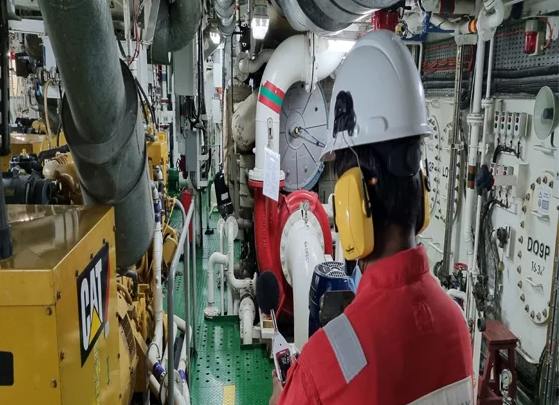
The importance of conducting regular noise monitoring and surveys cannot be overstated. It provides numerous advantages to industries, particularly because it gathers information that is otherwise less obvious or scattered. In Noise Surveys, there are generally three types of tests conducted:
1- Spot Readings: Spot readings are single readings taken with a handheld device. They are particularly useful for quick checks or to identify immediate noise levels in a specified area.
2- Continuous Monitoring: In this monitoring, the noise meter is installed at a specific location and measurements are taken at regular intervals. This helps to understand noise trends and fluctuations. Continuous monitoring gives a clear and detailed picture of how the sound level changes at different times.
3- Ongoing or Long-Term Monitoring: The sound levels are measured at small time intervals varying from 5 minutes to an hour, over different time periods ranging from weeks to months. This is done to understand the patterns of noise pollution and variations in the long run. Long-term monitoring is often used for urban planning, regulatory compliance, or environmental studies.
The importance of conducting regular noise monitoring and surveys cannot be overstated. In Noise Surveys,
A noise level meter, equipped with a microphone, a processor, a display and other components is calibrated before the noise survey to collect daytime and nighttime activities or as per the requirements. For spot readings, the operators measure sound at ear level near employees to replicate their daily exposure. In risky and dynamic environments, a personal sound exposure meter (PSEM) records the noise levels throughout shifts. For long-term and continuous monitoring, meters are installed on tripods at high-risk and high-exposure locations, and average levels are calculated to check employee exposure levels and ensure safety.
Ocean offers comprehensive noise survey services, ensuring a safer and more compliant work environment for workers across industries. We help you accurately identify and avoid noise hazards onboard, boosting crew safety and improving operational efficiency. Our experts comprise safety managers, plant engineers and industrial hygienists to confirm sound safety and avoid harmful noise levels.
The noise survey services we offer across Oman and the Middle East helped companies identify faulty equipment and hazardous locations with harmful levels of noise.
Ensure the safety of your marine crew and onboard assets with our expert noise survey solution. Optimise your operations with Ocean. Schedule a Noise Survey now!