
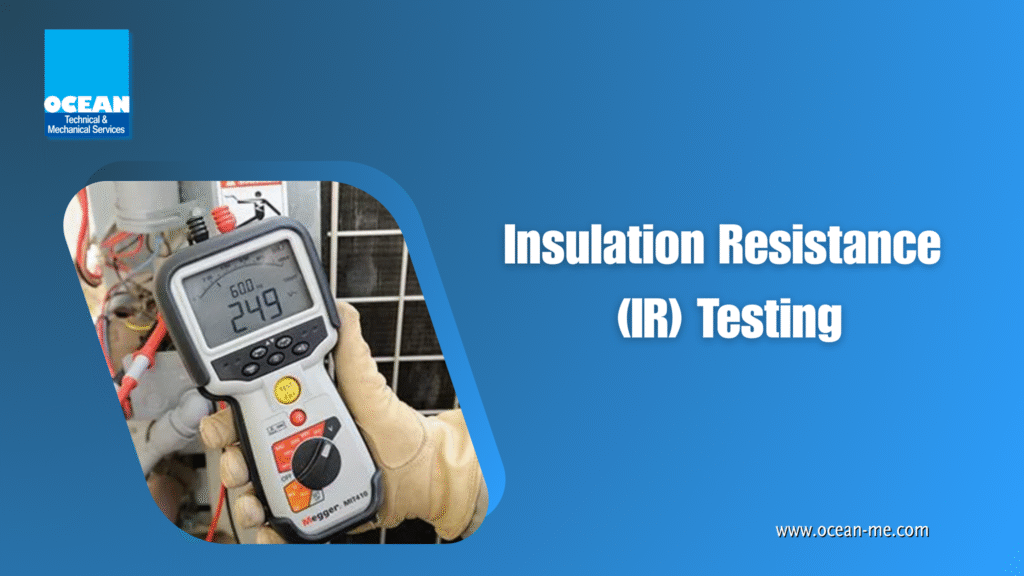
Insulation Resistance (IR) testing is an essential electrical safety assessment used to evaluate the condition and effectiveness of insulation materials in electrical systems. The main objective of this test is to identify early signs of insulation deterioration, which can otherwise result in equipment malfunction, electrical short circuits, overheating, arc flashes, fire hazards, or electric shock incidents.
IR testing plays a vital role in preventive maintenance by detecting insulation weaknesses at an early stage. Its advantages include minimizing unexpected equipment failures, improving electrical safety, extending asset lifespan, and enhancing operational reliability. This testing method is commonly applied to electrical cables, industrial installations, motors, generators, airport lighting systems, monitoring systems, and various commercial and industrial electrical appliances.
At Oceanme, experienced certified professionals combine technical expertise with advanced diagnostic instruments to deliver accurate insulation resistance testing services. Even complex electrical installations can be thoroughly assessed, enabling informed maintenance planning. Organizations seeking insulation resistance testing services in Oman can rely on Ocean for dependable solutions.
This article explores insulation resistance testing in detail, including its purpose, testing methods, procedures, and importance in maintaining safe electrical operations.
What is Insulation Resistance (IR) Testing?
Insulation Resistance testing is performed to measure the resistance offered by insulation materials in electrical equipment or cables. The test is carried out using an insulation tester, commonly known as a Megohmmeter or Megger, which is why it is often referred to as a Megger test.
The purpose of this diagnostic test is to verify how effectively insulation prevents unwanted current leakage. High resistance values indicate healthy insulation, while low readings may suggest moisture intrusion, contamination, aging, or physical damage. Identifying such issues early helps prevent operational failures and safety risks.
Why is Insulation Resistance Testing Necessary?
Electrical insulation gradually degrades due to environmental exposure and operational stresses. Factors such as temperature variations, humidity, chemical exposure, mechanical bending, UV radiation, and natural aging contribute to insulation deterioration over time.
Common stresses affecting insulation include:
- Electrical Stress: Caused by voltage fluctuations such as overvoltage or undervoltage.
- Mechanical Stress: Resulting from vibration, movement, or repeated operational cycles.
- Chemical Stress: Exposure to oils, vapors, or industrial contaminants.
- Thermal Stress: Continuous heating and cooling cycles or extreme temperatures.
- Material Stress: Aging or poor-quality insulation materials.
As these stresses accumulate, insulation resistivity decreases, allowing leakage currents to develop. IR testing detects these changes early by measuring leakage current and calculating resistance, enabling timely corrective actions.
Insulation Resistance Measurement Standards in Oman
Insulation resistance measurement in Oman follows international standards and local electrical regulations set by authorities such as APSR and Nama Electricity Distribution Company. IR testing is carried out using a DC insulation tester to evaluate the condition of insulation in electrical systems and prevent leakage currents or faults. For low-voltage circuits above 50 V, a minimum insulation resistance value of 1 MΩ is generally required in line with IEC standards, ensuring electrical safety, compliance, and reliable system performance.
How Insulation Resistance is Measured
During IR testing, a high DC voltage is applied across the insulation using an insulation tester. The instrument measures the resulting current flow and calculates resistance using Ohm’s Law:
R = V / I
Where:
- R = Resistance (ohms)
- V = Applied voltage (volts)
- I = Measured current (amperes)
Typical test voltages range from 100 VDC to 1000 VDC, suitable for insulation evaluation but not recommended for sensitive electronics. Because insulation resistance values are usually high, results are expressed in kilohms (kΩ), megohms (MΩ), gigohms (GΩ), or teraohms (TΩ).
Higher values indicate reliable insulation, while lower readings signal deterioration.
PAT Testing and Insulation Resistance
Portable Appliance Testing (PAT) evaluates the electrical safety of movable equipment. A PAT test typically includes:
- Insulation resistance testing
- Earth continuity testing
- Visual inspection and polarity checks
A common guideline is maintaining at least 1 MΩ insulation resistance per 1000 V of equipment rating. If measured values meet or exceed this threshold, the appliance passes the insulation test.
Insulation Resistance Testing Procedure
IR testing may be conducted independently using a Megger or as part of PAT testing. For large electrical systems, Meggers are preferred due to their higher voltage capability and measurement accuracy.
Typical testing steps include:
- Preparing and isolating the circuit
- Configuring the insulation tester
- Connecting test leads (Live, Neutral, and Earth)
- Performing the measurement
- Recording and evaluating results against standard limits
Environmental conditions significantly influence readings. For example, insulation resistance generally doubles for every 10°C decrease in temperature and reduces as temperature rises. Stable or increasing readings indicate good insulation condition.
Types of Insulation Resistance Tests
1. Short-Time (Spot Reading) Test
This method applies voltage for a short duration and records resistance at a specific time interval. It is suitable for equipment with low capacitance or short cable lengths and provides quick condition assessment.
2. Time-Resistance (Absorption) Test
In this method, voltage is applied over an extended period. Healthy insulation shows steadily increasing resistance, while contaminated insulation shows little change. This approach is useful for comparing motors regardless of size or rating.
Motor Insulation Resistance Evaluation
IR testing for electric motors measures resistance between windings and the motor frame. Typical evaluation criteria include:
| Insulation Resistance | Condition |
| ≤ 2 MΩ | Poor |
| 2–5 MΩ | Critical |
| 5–10 MΩ | Suspect |
| 10–50 MΩ | Good |
| > 50 MΩ | Excellent |
Equipment Used for IR Testing
Common tools used include:
- Insulation Tester (Megohmmeter or Megger)
- Portable Appliance Tester (PAT Tester)
These instruments apply controlled high voltage to accurately measure insulation resistance values.
Difference Between Dielectric Strength Test and IR Test
A dielectric strength test, also called breakdown testing, determines how much voltage insulation can withstand before failure occurs. It uses high voltage (usually AC) and is typically performed during product type testing using a hipot tester.
In contrast, insulation resistance testing is a non-destructive method using lower DC voltage to evaluate insulation condition during routine maintenance. Results are expressed as resistance values rather than breakdown voltage.
Factors Affecting Insulation Resistance Readings
- Capacitive Charging Current: Initially high and decreases after insulation charging.
- Absorption Current: Gradually reduces as insulation stabilizes.
- Leakage Current: Small steady current flowing through or across insulation surfaces.
Safety Measures During IR Testing
- Ensure equipment is fully isolated from power sources.
- Discharge equipment after testing for safety.
- Avoid testing in explosive or flammable environments.
- Apply lockout/tagout procedures.
- Verify secure connections before testing.
- Use safety barriers and warning signage.
- Prevent cable ends from accidental grounding or contact.
Insulation Resistance Testing Services by Oceanme
Oceanme provides professional insulation resistance testing services designed to enhance electrical safety, reliability, and compliance with international standards. Using calibrated instruments and advanced diagnostic techniques, certified technicians identify insulation issues before they lead to operational downtime or hazards. We also offer online and offline partial discharge testing.
Whether for commissioning, preventive maintenance, or troubleshooting, Oceanme delivers accurate analysis and practical maintenance recommendations to keep electrical systems operating safely and efficiently.
Contact Oceanme today to schedule insulation resistance testing services in the Oman to learn more about our electrical inspection solutions.