
Tan Delta (TD) analysis or Tan Delta Testing for spotting electrical and insulation faults in electrical systems like transformer is one of the most advanced and reliable electrical inspection and diagnostic methods. The operational life and maintenance schedules of high-voltage equipment depend largely on the integrity of the insulation systems. Tan Delta testing helps track subtle changes in insulation’s electrical properties and provides a clear picture of its true condition. This enables the maintenance team to intervene, take timely action and avoid unplanned downtime.
Insulation safety is of supreme importance; it works as an invisible shield in protecting the electrical assets such as transformers, power cables, motors and switchgears. But, over time, this insulation wears and deteriorates due to many reasons like thermal ageing, electrical stress, moisture and humidity, and contamination, leading to unexpected failures and operational outages. Detecting this insulation wear early is critical to preventing costly breakdowns and extending the electrical asset’s operational life.
At Ocean TMS, our team of skilled professionals meticulously conducts thorough analysis and performs TD testing to evaluate the condition of high-voltage insulation.
This article will explore the basics of Tan Delta testing, the step-by-step process and its key features– giving you a clear picture of this diagnostic method.
What is Tan Delta Testing?
Tan Delta (TD) testing, aka Loss Angle or Dissipation Factor, is a non-destructive testing method performed to assess the condition and quality of cable insulations within electrical systems. TD is an effective diagnostic method for finding electrical faults in cables, switchgear, and transformers.
Power cables in electrical systems are more than just conductors wrapped in insulation. From an electrical point of view, power cables are more like capacitors consisting of a central conductor and an outer metallic screen, with the insulation between serving as the dielectric. This feature enables capacitance to be measured, which is a crucial part of Tan Delta testing, done to evaluate the condition of insulation.
In a proper cable with no defects, the current flowing is entirely capacitive (IC), meaning it leads the applied voltage by 90 degrees.
But in real-world scenarios, insulation is never perfect. Over time, factors like electrical stress, contamination, thermal expansion and ageing can create faults. As a result, a small resistive current (IR) starts to flow in phase with the voltage alongside the capacitive current.
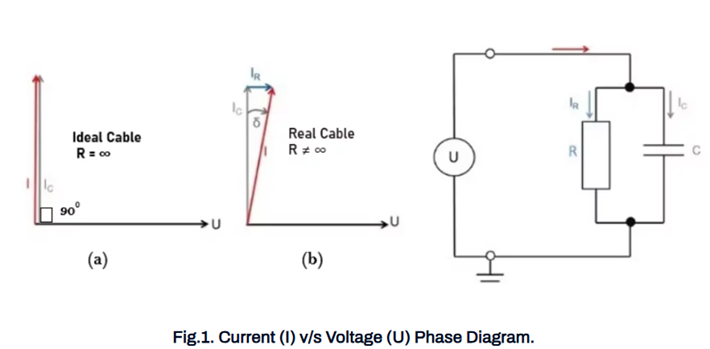
This is a phase diagram, and on this phase diagram, the resistive current changes the total current vector a little bit away from the ideal 90° position (Figure 2 (b)). So, the angle between the ideal capacitive (IC) and the actual current is called the Loss Angle (δ).
The total leakage (IL) can be shown as,
IL=IR+IC
In Tan Delta testing, the dielectric loss factor (tan δ) is calculated at different applied voltages to assess insulation performance. From the phasor (vector) relationship between currents, the dissipation factor is said to be:
tan δ= IR / IC
The ratio shows the proportion of resistive current to capacitive current in the insulation system. With TD testing, the maintenance team can track the insulation’s condition, identify faults, and intervene to avoid operational hindrance.
Why Tan Delta Testing?
Tan Delta testing has a very important role in picking the first signs of insulation weakening in high-voltage equipment such as cables, transformers and bushings. The test measures the loss angle (δ), which shows the phase difference between the ideal capacitive current (IC) and the actual leakage current (IL).
So, when the value of the loss angle increases, it indicates higher resistive losses, meaning the insulation is no longer acting like a perfect capacitor, as it is supposed to be, and its condition is degrading.
Let us look at the key advantages of Tan Delta Testing:
– Early fault detection: TD helps spot problems like moisture, contamination and insulation ageing before they turn into major issues.
– Non-Invasive: TD is carried out at controlled voltages and low frequencies, which ensures the equipment is not damaged while testing.
– Condition Trending: By comparing readings at different voltages, it becomes easier to track how the insulation condition changes over time.
– Reduced Maintenance Cost: TD enables planned maintenance and reduces the risk of sudden and unexpected breakdowns that lead to costly downtime.
– Longer Equipment Life: Tan Delta testing improves operating conditions, helping extend the critical assets’ lifespan.
– Reliable Results: Tan Delta testing helps in detecting the slightest changes in insulations, ensuring reliable and accurate assessment.
Tan Delta Testing Processes
Tan Delta testing process follows a thorough and rigorous process to deliver accurate and reliable measurements. The following are the processes involved in Tan Delta Testing:
1- Preparation of Equipment: This step involves disconnecting the cable, potential transformer, bushings, current transformer and windings that are to be tested from the rest of the system so the insulation can be evaluated independently.
2- Applying Test Voltage: The test is usually commenced by giving a minimal level of test voltage to the equipment under analysis.
3- Initial Measurement at Normal Voltage: The equipment’s rated operating voltage is applied, and the Tan Delta values are recorded using the tan delta controller, which would serve as the baseline reading.
4- Increasing the Voltage: Under this step, the voltage applied is raised to 1.5 to 2 times the normal operating voltage to create stress on the insulation under analysis.
5- Measurement at Increased Voltage: The Tan delta values at the elevated voltage level are again recorded at increased voltages to determine the variations.
6- Data Comparison and Analysis: Using a loss angle analyser, the Tan Delta values from normal voltage to elevated test conditions are compared. If the values stay stable and the insulation is likely in a good state, however, if the values vary significantly, then the insulation is expected to be faulty.
How to Predict the Result of Tan Delta Testing?
The condition and health of an insulation system can be predicted mainly via two methods of the Tan Delta Test:
1- By Comparing Trends: In this method, the most recent test results are compared with the previous measurements. If there is a considerable increase in the test values over the years, it means that there may be insulation deterioration caused by ageing, moisture ingress or contamination.
2- Direct Value Assessment: In this method, the value of tan δ reading is used to evaluate the insulation condition. A healthy insulation system will project similar tan delta values on all test voltages. However, if the insulation is weak, compromised, or deteriorated, the test values will vary and rise at increased voltage levels, which is a clear sign that indicates the insulation is deteriorating or under stress.
Different Modes of Tan Delta Test
In general, the Tan Delta test can be done in three main modes, with each mode focusing on different aspects of the insulation behaviour.
1. GST Guard Mode: In Ground Specimen Test (GST) guard mode, the Tan Delta measures only the leakage current that flows to the ground. This mode is particularly beneficial if you want to get just the ground leakage and involve no other leakage paths.
2. UST Mode: Ungrounded Specimen (US) Test mode measures the insulation between two ungrounded points within the equipment. This measurement mode is ideal for phase-to-phase insulation testing without any interference from ground connections.
3. GST Mode: All possible leakage paths are evaluated in GST mode. The results from GST Guard mode and UST mode are combined, and when added together, they should match the GST results.
If the sum of GST Guard and UST does not tally with the GST reading, it indicates:
– A fault or calibration fault in the equipment or
– Incorrect test connections or terminal setup
Tan Delta Testing in Oman and the Middle East with Ocean TMS
At Ocean TMS, we combine the most advanced diagnostic tools and the expertise of skilled professionals to give accurate and dependable Tan Delta testing solutions for the industry’s electrical systems especially transformers. Our specialist performs TD testing carefully and meticulously in controlled conditions to assess the insulation loss angle and identify even the smallest sign of deterioration.
By checking values at different voltage levels, we help the businesses get a clear picture of the electrical equipment’s condition – helping to foresee potential failures, plan maintenance more effectively and maximise asset life. From transformers and cables to rotating equipment, our Tan Delta testing will ensure your systems operate safely, efficiently, and in accordance with industry standards.
What’s more, our skilled team offers a range of condition monitoring services, including vibration analysis, laser alignment, infrared thermography, and more.
Don’t let unexpected faults interrupt your operations.
Schedule your Tan Delta testing in Oman or across the Middle East with OceanTMS today for a fast, precise, and efficient evaluation of your equipment insulation health.
FAQ
- What does Tan Delta Measure?
Tan Delta indicates the electrical insulation’s health by comparing the leakage current to the ideal Capacitive current. It helps find how much energy is being lost because of insulation imperfections. - What is the difference between the hipot & Tan Delta test?
A Hipot test checks if the insulation could withstand higher voltages by either passing or failing. While a Tan Delta Test gives in-depth analysis and insights into the actuation insulation condition, including ageing, moisture ingress and overall quality. - How to measure Tan Delta?
Tan Delta is calculated by applying a controlled test voltage to the insulation using special tools and equipment. The device then calculates the loss angle to evaluate the insulation performance. - How to interpret Tan Delta values and results?
When we get a consistent tan delta value over different sets of voltage levels, it usually means the insulation health is adequate. But, if the values vary and increase as the voltage rises, it may suggest insulation weakness, deterioration or contamination within.