
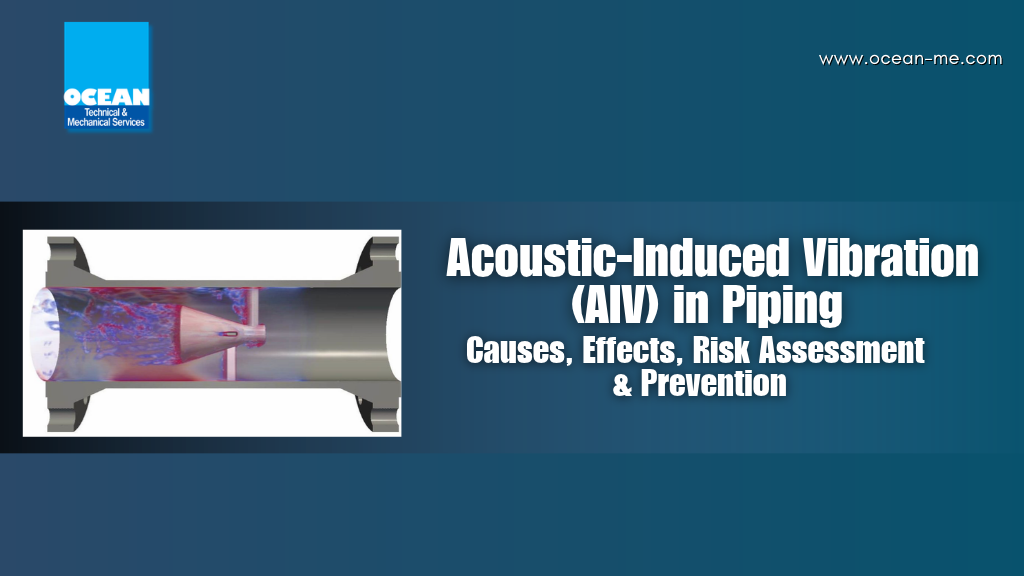
What Is Acoustic-Induced Vibration (AIV) in Piping?
Acoustic-induced vibration (AIV), is a serious piping-system condition caused by intense high-frequency sound waves travelling through a gas stream, mostly generated near high-pressure-reducing devices in piping systems. Acoustic-Induced Vibration (AIV) occurs when intense acoustic energy is generated by high-pressure drops across valves and other flow-control devices.
These high-frequency pressure fluctuations can cause the pipe wall to vibrate. Suppose leaving it undetected, this repeated vibration can lead to fatigue damage and eventually failure of critical piping components, fixing which requires complex procedures and costly systems.
So, how exactly does pressure variation generate acoustic energy? When a gas or vapour passes through a pressure-reducing device like a control or relief valve, a large pressure drop can occur, resulting in turbulent or unstable flow; this abrupt change in pressure and velocity causes pressure waves to propagate through the fluid as acoustic signatures. These high-frequency sound waves can disturb the piping wall, causing it to vibrate and creating cyclic stresses at the welded sites and various other vulnerable points.
AIV is a pressing concern in process piping systems because it can cause structural vibrations that place significant cyclic stress on piping components. If these vibrations continue over time, they can contribute to fatigue cracking, piping damage, unplanned shutdowns, and costly repairs, making early AIV assessment important for maintaining piping integrity and operational reliability.
AIV is not the only vibration-related issue that can affect piping system integrity; Flow-Induced Vibration (FIV) can also contribute to structural stress, fatigue, and potential damage under certain operating conditions. FIV or Flow-Induced Vibration, unlike AIV, is usually caused by fluid flow issues like turbulence or vortex shedding, flow separation or irregular flow conditions that can occur across a large area of piping and process equipment.
How Does Acoustic-Induced Vibration Occur?
Acoustic-Induced Vibration (AIV), like we discussed earlier, develops when high-velocity gas or steam passes through pressure-reducing devices, creating turbulence and rapid pressure variations within the flow. These disturbances produce high-frequency acoustic energy that travels through the piping and interacts with the pipe wall and connected components. When this acoustic energy couples with the piping structure, it can be transformed into mechanical vibration, generating cyclic stresses that may affect welded joints, branches, and other areas susceptible to fatigue.
The depth and intensity of the generated acoustic noise are influenced by factors like the pressure drop across the restriction and the mass flow rate of the gas or vapour. When the sound energy travels downstream, it slowly declines due to friction, energy transfer into pipe vibration, and heat dispersion. The acoustic signals can move along the piping from the activation source across the first major vessel, with the sound level usually reducing as the distance increases.
In AIV evaluation, an acoustic level around 155 dB is commonly used as an indication that circumferential pipe-wall vibration is not a major concern, but Industry experience indicates an approximate attenuation of 3 dB for every 50 pipe diameters (50D) from the source.
Common Sources of AIV in Piping Systems
AIV is most likely to develop where high-pressure gas or vapour experiences a significant pressure drop or flow restriction. The following are the common sources where AIV can be found in process piping systems:
- Control Valves: High pressure drops along control valves can result in turbulent, high-velocity flow and induce strong acoustic energy, especially when handling gas or steam.
- Pressure-Reducing Valves: These valves are designed and installed to intentionally reduce fluid pressure, and due to the rapid change in flow conditions high-frequency acoustic excitation are produced that is capable of creating vibration downstream piping system.
- Letdown Valves: These valves which are used to reduce pressure in process systems, can generate substantial noise and acoustic signals when interacting with large pressure differentials.
- Orifices and Restriction Devices: Sudden restrictions and hindrances in the flow path produce intense turbulence and can cause pressure fluctuations and acoustic energy downstream of the restriction.
- Blowdown Systems: Rapid depressurisation of high-pressure gas can produce very high flow velocities and intense acoustic energy, making blowdown piping particularly vulnerable to AIV.
- Vent and Flare Systems: High-velocity discharge through vents and flare systems can create significant acoustic disturbances, especially where large pressure differences and gas flow rates are involved.
- High-Pressure Gas and Steam Lines: Piping systems carrying high-pressure gas or steam are more vulnerable when the flow passes through restraints, valves, or other components that limit or cause substantial pressure drops and turbulent conditions.
Understanding the AIV Failure Mechanism
Acoustic Induced Vibration (AIV) typically develops when high-velocity gas or vapour passes through pressure-reducing devices, control valves, restrictions, or other flow disturbances within a piping system. The sudden pressure drop and turbulent flow generate high levels of acoustic energy, which travels through the fluid as pressure waves.
When these waves come in contact with the pipe wall and connected components, they can excite the piping structure and produce vibration, affecting vulnerable parts of the piping system. The effect is more pronounced at locations such as small-bore or branch connections, welds, fittings, and other areas where local stresses can become concentrated.
Continued exposure to this vibration produces repeated cyclic stress in the affected piping components. The stress from a single vibration cycle might look relatively small, but repeated cycles can progressively weaken the material and start fatigue damage. Small cracks might first appear at highly stressed or geometrically vulnerable locations and can gradually grow as the system continues to operate.
If the condition remains undetected, the damage can advance to larger cracks, loss of containment, leakage, or failure of the piping component. So, quick identification of AIV risk and appropriate assessment of vibration and stress levels can significantly help prevent fatigue-related damage or any unplanned shutdowns.
Where Does AIV Damage Typically Occur?
AIV damage is most likely to develop at piping locations that are more vulnerable to vibration and cyclic stress, particularly where components create local stress concentrations or disrupt the flow-related acoustic energy. Common areas include:
- Small-bore connections
- Instrument connections
- Branch connections
- Welded attachments
- Thermowells and other protruding components
- Downstream piping near valves and restriction devices
Effects and Consequences of Acoustic-Induced Vibration
Persistent Acoustic-Induced Vibration can put piping and its connected components under repeated dynamic stress, affecting structural integrity and reliability gradually. If the vibration is overlooked and not addressed properly, the fatigue damage can develop into leaks, equipment problems, operational interruptions, and safety concerns. The following are the aftereffects and consequences of AIV:
- High-cycle fatigue: Continuous vibration puts piping components under stress cycles, which can gradually reduce their life even when individual stress levels are relatively low.
- Weld cracking: Repeated cyclic stresses can concentrate around welds and heat-affected areas, allowing fatigue cracks to start and grow.
- Small-bore connection failure: Small-bore branches and instrument connections are very sensitive to vibration and could experience intense movement and eventual connection failure.
- Pipe and component damage: Continuous vibration can damage piping, supports, fittings, valves, and other connected components via repeated mechanical stress.
- Leakage of hazardous fluids: Cracks or compromised connections can release process gases, vapours, or other hazardous fluids, causing operational and safety concerns.
- Unplanned shutdowns: AIV-related damage might call for emergency repairs, equipment isolation, or shutdown, causing unexpected interruptions in production.
- Safety and environmental risks: Leaks or compromised fixtures can expose personnel to hazardous substances and various other emissions or other environmental impacts.
AIV Risk Assessment: How Is the Risk Evaluated?
AIV risk assessment is carried out to analyse whether high-velocity gas generates enough energy to excite piping and result in fatigue issues. The assessment usually commences with a general analysis of pipe conditions and identifying potential noise sources, after which the piping configuration is checked and its ability to withstand the vibrations is thoroughly analysed. The general steps involved:
Step 1: Identifying potential AIV sources:
The assessment usually begins by checking the equipment and piping components where there is a potential chance of pressure reduction or turbulent gas flow. The common sources are control valves, restriction orifices, vents, blowdown systems and other parts that are associated with high-pressure flow (gas or vapour)
Step 2: Understand pressure drop and operating conditions:
The pressure conditions upstream and downstream of the inspecting source are checked along with flow rate, temperature, gas properties, density, molecular weight, and other related process parameters. The pressure decline is a decisive element because a large pressure drop is a source for generating substantial acoustic energy.
Step 3: calculate acoustic power:
The next step is to estimate the acoustic power generated by the high-energy flow. This generally involves evaluating the pressure drop, flow characteristics, and properties of the flowing medium to see the amount of acoustic energy being put into the piping. Various calculations or set screening methods are used to estimate the acoustic power and its intensity.
Step 4: Detailed assessment for high-risk systems:
For systems posing potential risk, thorough engineering assessment is carried out, which involves more detailed and comprehensive analysis of acoustic generation, sound transmission, piping vibration interaction, structural stress or fatigue and various other connection details. The assessment usually involves detailed modelling or vibration analysis to identify vulnerable locations and determine if any further design modifications are required.
Step 5: Implement Risk-mitigation measures:
If the analysis and assessments showed increased vibration levels or elevated AIV risk, controls and modifications could be implemented. Depending on the source and piping arrangement, steps like reducing pressure drop, modifying the flow path, increasing pipe wall thickness, improving supports, reducing unsupported spans, or redesigning vulnerable small-bore and branch connections could be implemented.
Step 7: Documentation of the AIV assessment:
Finally, the assessment results are to be documented; the details include identified sources, process conditions, acoustic calculations, piping susceptibility, screening results, detailed analysis if applicable, and recommended design actions. This provides a traceable engineering basis for confirming the integrity and reliability of piping exposed to potential Acoustic-Induced Vibration.
Acoustic-Induced Vibration vs. Flow-Induced Vibration
| Acoustic-Induced Vibration (AIV) | Flow-Induced Vibration (FIV) |
| Mainly related to acoustic energy | Related to fluid-flow forces |
| Common in high-pressure gas/vapor systems | Can occur in both liquid and gas systems |
| Usually associated with large pressure drops | Usually associated with turbulence and flow irregularities |
| Can result in high-cycle fatigue | Can cause fatigue, wear and other vibration-related damage |
How to Detect Acoustic-Induced Vibration
Detecting Acoustic-Induced Vibration (AIV) reliably involves integrating and combining visual, acoustic, and vibration-based inspection methods to correctly identify abnormal operating conditions and early signs of fatigue. A structured assessment plan and strategic processes help locate vulnerable piping components and determine whether further investigation or corrective action is required.
- Visual inspection: Check piping, supports, welds, and connections for visible movement, damage, looseness, or other signs associated with vibration.
- Vibration Analysis measurements: Measure vibration levels on piping and components to identify abnormal vibration amplitude and changes from normal operating conditions.
- Acoustic Emission Testing: Use suitable acoustic measurement techniques to check high-frequency noise and identify areas exposed to elevated acoustic energy.
- Identifying unusual noise: Listen for unusual hissing, buzzing, or high-frequency noise near valves, restrictions, and other potential AIV sources.
- Inspection of welds and small-bore connections: Examine vulnerable areas for signs of fatigue, cracking, looseness, or excessive vibration.
- Non-destructive testing for suspected fatigue cracks: Apply appropriate NDT methods to investigate suspected cracks or defects without damaging the component.
- Condition monitoring Services: Set baseline measurements and periodically monitor vibration and acoustic conditions to identify developing AIV-related issues early.
AIV Prevention and Mitigation Methods
AIV can be controlled by reducing acoustic energy at the source and reinforcing vulnerable piping areas. Early design-stage assessment helps minimise fatigue risks and significantly reduce costly modifications later.
- Reduce pressure drop: Minimise excessive pressure reduction across individual components.
- Use multi-stage reduction: Distribute pressure drop across multiple stages.
- Optimise valves and restrictions: Select flow devices with lower noise and AIV potential.
- Modify piping configuration: Improve routing and connection arrangements to reduce vibration.
- Reinforce small-bore connections: Strengthen vulnerable branches and attachments.
- Improve piping support: Add suitable supports and restraints for better stability.
- Reduce unsupported spans: Shorten spans to increase piping stiffness.
- Relocate vulnerable components: Move or redesign components exposed to high AIV risk.
- Apply design-stage controls: Include AIV screening and mitigation early in the design process.
AIV in Piping: Design Considerations
AIV potential should be considered from the initial stages of piping design, particularly for high-pressure gas and steam systems where significant pressure drops can generate acoustic energy. Proper selection of valves and restriction orifices, careful design of small-bore connections, adequate piping supports, suitable flexibility, and optimised layouts can help reduce vibration risks. Incorporating AIV screening and engineering assessment into the design process allows potential problem areas to be identified early and appropriate mitigation measures to be included before installation.
Why Early AIV Detection Matters
Early detection of Acoustic-Induced Vibration (AIV) helps identify developing vibration and fatigue risks before they result in significant piping or component damage. By recognising abnormal acoustic and vibration conditions at an early stage, plants can take timely corrective action, protect critical systems, and maintain safer, more reliable operations.
- Prevents fatigue-related failures: Identifies vibration conditions that could contribute to high-cycle fatigue and cracking in piping components.
- Reduces unplanned downtime: Allows potential AIV issues to be addressed before they lead to unexpected equipment or process interruptions.
- Protects piping integrity: Helps safeguard pipes, welds, branches, and small-bore connections from excessive vibration stresses.
- Improves plant reliability: Supports continuous and dependable operation by identifying developing problems before they become major failures.
- Reduces maintenance costs: Early intervention can minimise extensive repairs, component replacement, and emergency maintenance.
- Supports process and personnel safety: Reducing the likelihood of vibration-related leaks or failures helps maintain safer operating conditions.
Concerned About Acoustic-Induced Vibration in Your Piping System in Oman?
Being the leading engineering company in Oman, Ocean TMS provides expert Acoustic-Induced Vibration (AIV) assessment and engineering analysis to help identify potential vibration risks in piping systems. Our specialists evaluate AIV-related risks that could contribute to fatigue damage, cracking, and unexpected equipment or piping failures. Contact Ocean TMS to discuss your piping system and get a professional AIV assessment tailored to your operational requirements.