

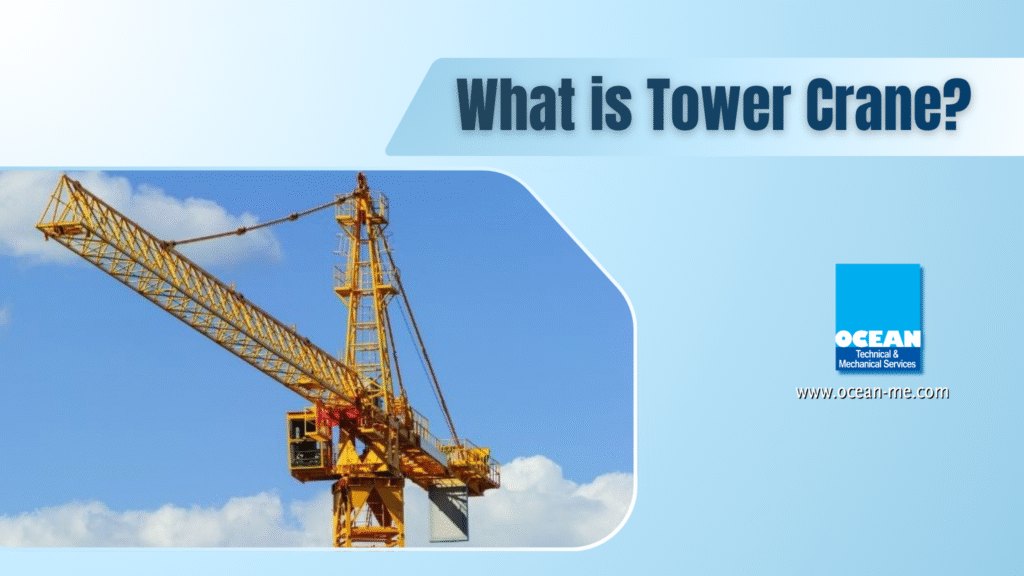
Tower cranes are gigantic, stationary cranes that you see high above buildings under construction, specially designed to lift and move around heavy construction items, such as steel, concrete, and large supplies, high above. Tower cranes are an imperative element in building high-rise structures. A single foundation backs tower cranes, yet they cover a greater radius. Installing these structures requires meticulous precision and complex care.
Have you ever wondered how they erect these tall giants above the skyscrapers? And what is the process involved?
A tower crane is generally installed with the help of a mobile crane, which is used to assemble the parts of the tower crane, such as the mast, jibs, slewing units, etc. Operating a tower crane is not something just anyone can do. It requires proper hands-on training and skills to handle the job safely and confidently.
The Role of Tower Cranes in Construction
Tower cranes play a vital role in everyday modern construction, to transport construction materials to great heights, to build bridges, and other large structures. The following are the reasons why they are still pivotal to construction:
- Lifting heavy materials efficiently and safely
- Reaching great heights without occupying much ground space
- Improving work speed and productivity on site
- Supporting the construction of skyscrapers, bridges, and large infrastructure projects
The tower cranes are really necessary, allowing builders to move materials precisely where they are needed, even at extreme heights.
Tower crane Parts you should know
Let us look at some of the critical terms associated with tower cranes:
Foundation: the foundation, or the concrete foundation, is basically the core part of the tower cranes, providing the strong base for operation, stability, and support for the entire crane system to be dependable across work sites.
The Mast: Mast or the Tower is the tall, vertical section of the tower crane, where sections can be added or removed according to the requirements. The mast needs to be strong to support the weight of the crane and the load.
The Slewing Unit: The slewing unit is placed at the top of the mast, below the working cabin. It is a rotating mechanism allowing the crane to rotate horizontally.
The Jib: The Jib, or the Boom, is the horizontal, extended long arm away from the slewing unit used to lift and manoeuvre the loads in different directions.
The Machinery Jib: or the Counter Jib, is a smaller arm that extends in the opposite direction away from the main jib, providing counterbalance to keep the crane stable and from tipping off.
The Trolley: This is a motorised movable carriage that moves across the jib, providing support while the load moves back and forth. It uses pulleys to move the load across the jib.
The Hoist: The hoist is the lifting system of a tower crane that raises and lowers loads using a wire rope, drum, hook, and a series of pulleys. It is powered by a motor that allows sharp vertical movement of heavy materials during lifting.
The Hook: The hook is the component that attaches the load to the hoist; it may change depending on the type of loads the crane is handling.
The operator Cabin: This is where the crane operator sits and controls the crane system and movements. The crane operator must be skilled in managing the complexities of the crane.
The Crane System: The crane control system manages the crane’s movements and controls, as well as handling loads and implementing safety features. This system combines hydraulic and electronic technologies to ensure efficient and safe operation.
The Counterweight: The counterweight is placed behind the operator’s cabin and keeps the crane steady and stable by balancing the load when it turns.
Climbing System: The climbing system includes hydraulic jacks or self-climbing components to lift the tower crane itself during assembly. It helps to lower and dismantle the crane when the job is done.
The Three Main Types of Tower Cranes
Tower cranes are built differently to suit different lifting needs and site conditions. Choosing the right crane type not only improves safety but also helps tasks process faster on site. The three commonly seen types of tower cranes are:
- Hammerhead Tower Cranes:
As the name suggests, the hammerhead cranes have a fixed horizontal jib and counter-jib, which looks like a hammer-like shape. This particular design gives a good balance and is ideal for lifting heavy loads on large construction sites. - Luffing Jib Tower Cranes:
Luffing jib tower cranes have a jib that can be positioned upward or downward, making it easier to work in constricted areas. They are mostly used on high-rise projects where space is a challenge, or there are nearby buildings that allow minimal and restricted movement. - Self-Erecting Tower Cranes:
Self-Erecting Cranes are mainly designed with a focus on convenient transportation. These cranes use built-in hydraulics to assemble and dismantle themselves without additional lifting equipment. They are ideal for smaller job sites or areas with limited access and space.
Key Points About Tower Crane Assembly
Tower cranes are an absolute symbol of modernisation and progressiveness. Bridges, flyovers, skyscrapers, and tall structures are erected effortlessly with the help of these gigantic cranes. Despite simplifying the loading process, these giant helpers need careful assembly before they can perform assigned tasks. They are often erected piece by piece, where each pieces are erected with utmost precision.
- Tower cranes are assembled in sections using mobile cranes
- The foundation must be strong and properly engineered
- As the building grows taller, the crane can be “climbed” to increase its height
- Assembly and dismantling must be carried out by trained professionals
- Safety checks are critical at every stage of installation
Steps Involved in Tower Crane Erection:
- Planning and preparation before crane erection: detailed site analysis and thorough planning are quintessential before deciding on the installation of tower cranes. Expert engineers and crane specialists perform a variety of evaluations, such as soil tests, to ensure the feasibility of the cranes in a particular location and that the ground can hold the crane’s weight.
- Foundation or the Base: Following proper analysis and initial testing, a concrete base or a steel foundation is set, with the measurements and the dimensions all depending directly on the gathered evaluations. Anchor bolts are secured into the concrete to hold the crane base. Once the concrete is completely cured, the base section is mounted and aligned. The base supports and holds the whole tower crane, its size and the load capacity, and so the foundation needs to be strong and reliable.
- Installing the Mast Sections: After the foundation is fixed, the initial mast sections are assembled using mobile cranes. The steel sections are joined section by section vertically to form the main tower. Every mast section must be carefully lifted and bolted to the main tower. The desired level of height is achieved as more mast sections are installed.
- Slewing Unit or Jib placement: The slewing unit is placed on top of the mast, which allows the crane to turn around smoothly. After attaching the slewing unit comes the jib or the arm and the counter-jib. These parts let the crane move loads horizontally along the construction sites. Meticulous alignment and precise installation of each part are crucial as they ensure balanced rotation, load handling and controlled movement.
- Counterweight installation: Concrete or steel counterweights are added to the counter-jib once the jib is in place. These counterweights help balance the total load the crane lifts and prevent the crane from tipping. The counterweights are installed in different stages depending upon the crane’s design and its lifting capabilities. Proper counterweight placement is crucial for safer operation.
- Climbing Process: As the construction progresses, the crane’s height is improved and added using a climbing frame. The crane lifts itself, and additional mast sections are added under the slewing unit. The process would be repeated until the crane achieves the needed height. The climbing process lets the crane adjust height and add sections without dismantling it.
- Testing and Commissioning: When the tower is fully assembled, a thorough evaluation is conducted to double-check that all the parts are installed and are working correctly. The load limits, hoisting mechanisms, slewing motion, braking system, controls, hydraulics and safety devices are carefully tested before trial lifts. Trial lifts are conducted to confirm balance, stability and smoother working. The crane is green signalled to operate only after passing all the inspections and safety checks at work sites.
Tower Crane: How much weight can they lift?
Tower cranes can lift between 6 to 20 tonnes, but this depends on the crane model and its configuration. The tower crane’s maximum lifting capacity depends on the position of the load, whether the load is positioned close to the mast or at the end of the jib. When the load is placed closer to the mast, the crane can handle heavier loads safely. The load capacity significantly reduces as the weight moves away from the mast and farther along the jib. Most of the tower cranes can lift 1-3 tonnes at the jib’s end. Load charts are referred to by the operators to understand safe limits for each radius. Tower cranes are ideally safe if the loads are within the safe limits.
Why wouldn’t these cranes topple over?
Tower cranes are specially designed to lift heavier loads, and so they are anchored to a strong concrete foundation that bolts them strongly to the ground. Heavy counterweights added to the counter-jib help balance the loads when loads are lifted on the working jib. The crane’s weight distribution is carefully calculated to keep the crane stable from tipping over. In taller structures, the crane is sometimes tied to the building to provide additional support. All these combined measures ensure the stability of the crane even when handling heavy loads and strong winds.
How Long Does it Take to Erect a Tower Crane?
Erecting a tower crane can take from 3 to 7 days, which purely depends on the crane size, complexity, site conditions and the availability of workers and supporting cranes. Smaller cranes can be assembled faster, while taller and complex cranes might take longer. The erection process involves foundation laying, mast assembly, jib setting and testing. The climate, site conditions, and availability of mobile cranes may also affect the time taken to erect the tower cranes.
Safety Measures During Crane Erection
Strict safety measures are followed while tower cranes are erected to protect workers, the construction structures and nearby equipment. Professional operators, certified riggers and expert engineers are assigned to oversee each and every stage of crane assembly. The components are carefully inspected before lifting and assembly. Regular communications and proper adherence to safety standards are ensured to plan the safety crane installation.
The following are the additional safety measures during crane erection:
- Planning: A proper crane erection plan must be in place well in advance, covering location, sequence, and timing to identify any defects or damages that could compromise safety.
- Equipment Inspection: All the crane components must be properly and carefully inspected before installation and erection processes to ensure safety and dependability.
- Personal Protective Equipment and Gear: Workers must wear helmets, safety harnesses, high-visibility vests, and safety shoes to reduce the risk of injury on work sites.
- Training and Certification: Qualified, certified, and skilled personnel should only be part of the crane installation activities.
- Emergency Procedures: The installation team should be well-versed in the emergency protocols and procedures to ensure readiness and respond quickly in an incident.
What to Choose: Mobile Crane vs. Tower Crane
Mobile Cranes or Tower cranes are both chosen based on their varied functions and the site requirements. Mobile cranes are ideal for short lifting works and for projects that require flexibility and fast setup. On the other hand, Tower cranes are best suited for long-term construction setups and for high-rise structures. Tower cranes offer greater heights, continuous lifting capability and provide better efficiency for repeated lifting, while mobile cranes are fast to deploy. Choosing the right crane greatly depends on project periods, height, load requirements, and site conditions.
Crane Erection with Oceanme
At Ocean Technical and Mechanical Services (TMS), crane erection and maintenance are handled with utmost precision, care, expertise, and a commitment to safety. Our experts are certified professionals who follow industry-approved crane erection protocols and international safety standards. Right from the foundation building to final commissioning, each process is carefully considered and meticulously executed to avoid delays and safety compromises.
Ocean combines advanced lifting equipment and technologies to ensure smooth installation. Our crane erection services are all-inclusive, starting from the basic planning, assembling, dismantling, to relocation. We work closely with our clients to ensure proper delivery and to align crane erection with project timelines.
Ocean TMS has a strong reputation partnering with some of the most renowned industry experts, backed by over years of hands-on experience. Our reliable, cost-efficient, and transparent approach makes us a trusted choice for clients.
For industrial crane installation in Oman, along with services such as maintenance, condition monitoring, machinery diagnostics, product distribution, and MRO spare parts supply, Ocean TMS stands out as a dependable partner. Supported by a skilled and dedicated team, we consistently deliver high-quality crane installation and related services with a focus on safety and performance.
Partner with Ocean TMS for professional and reliable crane installation and maintenance services in Oman. Contact us today to get expert support.
FAQs
- How are cranes erected on site?
Cranes are assembled in a step-by-step process, generally using auxiliary mobile cranes to lift and anchor together the base, mast, jib and counterweights.
- How does a crane get to a construction site?
Crane parts are transported separately by trucks and assembled on site using mobile cranes.
- How do you put a crane on a building?
The crane is erected on the ground and then climbs up as the building construction works progress, with mast sections added using hydraulic climbing systems. The crane is securely connected to the building at multiple levels using tie-in frames.
- How are cranes attached to the ground?
They are anchored and bolted to a strong concrete foundation for added stability and to avoid tipping over.